Kabaddi Techniques Guide: Hand Touches, Toe Touches and Defensive Holds
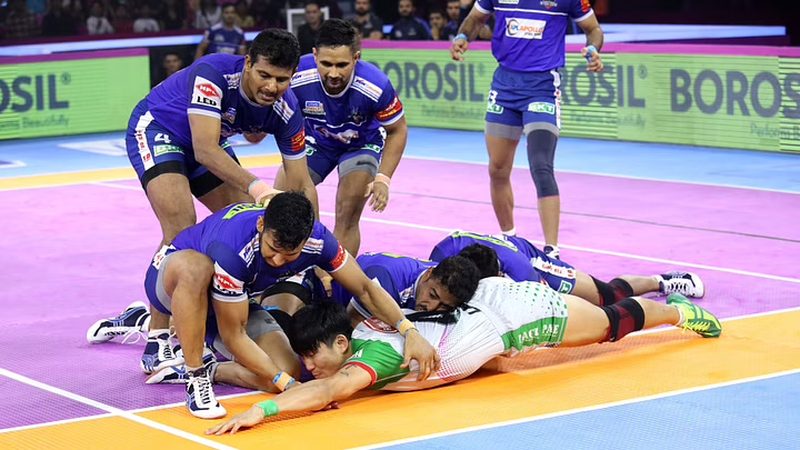
Watch a kabaddi raid in slow motion and you will see a martial art disguised as a game. The raider’s darting hand touch, the defender’s perfectly timed ankle hold and the split-second decisions in between are the product of years of drilled technique. This guide breaks down kabaddi’s core attacking and defensive skills, how they are executed and when the best players deploy them.
The hand touch: speed over strength
The hand touch is kabaddi’s simplest and most elegant attacking skill. The raider extends an arm at full stretch to brush a defender, often the nearest corner defender, and retracts it before the defence can react. The technique depends on explosive footwork: the raider feints one way, plants the outside foot and lunges, keeping the body low and the weight ready to spring back toward the centre line. Elite raiders disguise the touch until the last instant, using shoulder dips and eye movement to freeze the defender. The hand touch is the weapon of choice against passive defences and in the dying seconds of a raid when a single point will do.
How does the toe touch work?
The toe touch is the hand touch’s lower-body equivalent and one of the most spectacular sights in kabaddi. The raider swings a leg out to graze a defender’s foot or ankle, usually targeting a defender who has stepped too close to the baulk line. It requires extraordinary balance and hamstring flexibility, because the raider must extend fully while keeping the supporting foot planted and the body coiled to retreat. The best exponents use it against deep defensive lines, striking from a distance where defenders feel safe. Like the hand touch, its power lies in surprise: the leg shoots out and returns in a fraction of a second.
What other attacking skills do raiders use?
Top raiders carry a full arsenal beyond the basic touches. The running hand touch combines a sprint across the court with a touch on the move, useful against scattered defences. The dubki, or duck, is kabaddi’s signature move: the raider dives low under the outstretched arms of defenders, slipping through a gap and emerging on the other side. The jump and touch uses a leap to clear a defender’s attempted hold while tagging him mid-air. Kicks, including the side kick and the back kick, let the raider strike defenders behind him without turning. And the frog jump, a squat leap over a diving defender, turns a tackle attempt into a highlight. The great raiders chain these skills together, so defenders never know which weapon is coming.
The ankle hold: defence’s first weapon
If raiding is kabaddi’s art, the ankle hold is its science. The defender dives at the raider’s trailing leg as he retreats, grips the ankle with both hands and pulls it toward himself while teammates pile on. Timing is everything: dive too early and the raider steps over; too late and he is already across the centre line. The technique demands a low body position, strong wrists and the courage to throw oneself at a sprinting opponent’s legs. Coaches drill it endlessly because a reliable ankle hold is the foundation of every defensive system. Variations include the single-leg dive, where the defender commits fully, and the delayed hold, where he waits for the raider to overextend.
How do thigh holds and waist holds work?
The thigh hold is the ankle hold’s bigger brother. The defender wraps both arms around the raider’s thigh, driving his shoulder into the leg and using his body weight to halt momentum dead. It is devastating against raiders who rely on power, because it stops the drive toward the centre line instantly. The waist hold is the most physical tackle in the game: the defender encircles the raider’s waist from behind or the side, lifts him off the ground and pins him before he can reach safety. It requires immense core and grip strength and is often finished with help from teammates who grab the raider’s legs. Both holds carry risk: mistime them and the raider slips through for a multi-point raid.
Defensive systems: how seven players hunt as one
Individual tackles matter, but elite defence is a system. Teams set up in formations, usually with corner defenders holding the edges and covers and ins protecting the middle. The chain tackle sees two defenders link arms to present a moving wall. The dash uses coordinated body weight to shepherd the raider out of bounds. Defenders communicate constantly, calling the raider’s position and timing their dives together so that one man’s attempt sets up another’s. Modern teams study video to identify each raider’s favourite skills and set traps: showing a gap on one side while the ankle-hold specialist waits on the other.
- Hand touch: lightning arm extension to tag a defender and retreat.
- Toe touch: leg swing to graze a defender’s foot from distance.
- Dubki: low dive under defenders’ arms to slip through the line.
- Ankle hold: diving grip on the raider’s trailing leg.
- Thigh hold: wrapping the raider’s leg to kill momentum.
- Waist hold: lifting and pinning the raider off the ground.
FAQs
What is a dubki in kabaddi? A raiding skill in which the raider dives low under the arms of defenders to slip past them, one of the sport’s most spectacular moves.
Which is the most common tackle in kabaddi? The ankle hold, because it is the safest and most drilled defensive technique, forming the base of most teams’ defensive plans.
Can defenders use their full body to tackle? Yes, within the rules: holds, blocks and dashes are legal, but dangerous play and deliberate injury are penalised.
Hand touches and thigh holds, dubkis and dashes: kabaddi’s techniques are a complete combat vocabulary. Learn to spot them in real time, and every raid becomes a chess match played at sprint speed.
Source: Amateur Kabaddi Federation of India coaching manual

Khabar 24h Editorial Desk — our explainers are prepared by the Khabar 24h editorial team using AI-assisted research tools, and every piece is reviewed by a human editor before publishing. We do not claim original reporting: our work is turning complex topics into simple, accurate summaries. Spotted an error? Write to contact@khabar24h.com — our corrections policy aims for same-day review.
More from this author →