Cricket Fitness Standards: Yo-Yo Test, Training and Diet of Modern Cricketers
Cricket was once the sport where fitness was optional, where great players carried a little extra weight and nobody thought twice about it. That era is gone. The modern cricketer is a professional athlete in the fullest sense: sprinting between wickets, diving on the boundary, bowling at 140 kph through long spells, and doing it across formats with barely a break. Behind the performances lies a rigorous world of fitness testing, strength training, nutrition planning and recovery science. This guide explains the standards, the tests, the training and the diets that power today’s game.
The yo-yo test and cricket’s fitness benchmarks
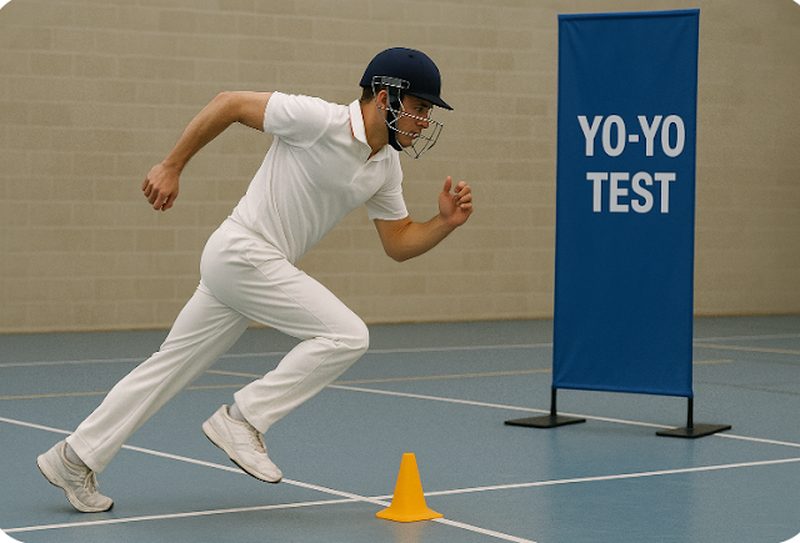
The most famous gatekeeper in modern cricket fitness is the yo-yo test, an intermittent running assessment that has decided selection debates and ended careers. The test is brutally simple: players shuttle between markers 20 metres apart, keeping pace with audio beeps that get progressively faster, with brief recovery walks between shuttles. The score is the total distance covered before the player can no longer keep up. Elite cricket teams set minimum thresholds, once widely reported around the high teens in level terms, and players who fail face consequences ranging from extra conditioning blocks to exclusion from selection. The test’s logic is cricket-specific: the sport demands repeated short bursts of high intensity, sprinting, diving, turning, separated by brief recoveries, exactly what the yo-yo simulates. It is supplemented by sprint timings, agility tests and body-composition assessments, but the yo-yo score remains the number everyone knows and nobody wants to fail.
How cricketers train: strength, speed and skills
Modern cricket training is periodised like any elite sport, with programmes built around the calendar’s demands. Strength work focuses on the qualities cricket needs: lower-body power for sprinting and bowling, rotational core strength for batting and throwing, and shoulder durability for the throwing and bowling loads. Fast bowlers follow carefully managed bowling-load programmes, building up overs progressively to protect against the stress injuries that have ended so many quick careers. Speed and agility sessions sharpen the first-step quickness that turns singles into twos and half-chances into wickets. Fielding drills are now high-intensity athletic workouts in their own right, with diving, sliding and throwing practised at match pace. And through it all, skills training continues: nets, throwdowns and scenario practice, because fitness is only useful if it serves the cricket. The best programmes integrate everything, so a player peaks physically for the series that matter most.
Diet: the fuel behind the fitness
Nutrition in elite cricket has been revolutionised. Gone are the days of heavy team meals and indifferent hydration; today’s players work with dietitians on individualised plans built around training loads, body composition goals and match schedules. The foundations are unglamorous: adequate protein for muscle repair, roughly two grams per kilogram of body weight for heavy training blocks; carbohydrates periodised around workload, high on intense days, moderated on rest days; and healthy fats for hormonal health. Match-day nutrition is precisely timed: pre-game meals rich in slow-release energy, gels and drinks during long innings, and rapid post-match protein and carbohydrate intake to kickstart recovery. Hydration strategies account for heat and humidity, with electrolyte drinks replacing what sweat takes out, a critical factor in subcontinental summers. Many teams now travel with chefs, and players’ body-fat percentages and hydration markers are monitored as closely as their batting averages.
Recovery, sleep and the longevity game
Training is only half the equation; adaptation happens in recovery. Sleep is treated as a performance tool, with teams monitoring sleep quality and duration, especially on tours across time zones. Ice baths, compression garments, massage and physiotherapy manage the daily damage of a brutal schedule. Load management, once a euphemism for resting stars, is now a science: GPS data, wellness questionnaires and bowling-load counts feed into decisions about who plays and who rests. The payoff is visible in career longevity: fast bowlers playing into their mid-thirties, batters maintaining reflexes deep into long careers, and fielding standards that would have seemed superhuman a generation ago. Fitness has become a skill, and like any skill, it rewards those who work at it.
- The yo-yo test measures repeated high-intensity running capacity; failing team benchmarks can affect selection.
- Fast bowlers’ workloads are managed in overs bowled, with progressive build-ups to prevent stress injuries.
- Elite cricket diets periodise carbohydrates around training load and prioritise protein for recovery.
- Sleep monitoring and load management are now standard tools for extending careers.
FAQs
What is a good yo-yo test score for a cricketer? Elite international teams expect scores well into the high teens; the exact benchmark varies by team and era.
Do spinners need the same fitness as fast bowlers? The demands differ, but modern standards apply to all: agility, endurance and body composition matter for every role.
Has fitness really changed cricket? Yes. Fielding standards, bowling speeds sustained through spells, and career longevity have all been transformed by professional conditioning.
The modern cricketer is built as much in the gym and the kitchen as in the nets. In a sport of fine margins, fitness is often the margin.
Compiled by the Khabar 24h Editorial Desk from publicly available sources.

Khabar 24h Editorial Desk — our explainers are prepared by the Khabar 24h editorial team using AI-assisted research tools, and every piece is reviewed by a human editor before publishing. We do not claim original reporting: our work is turning complex topics into simple, accurate summaries. Spotted an error? Write to contact@khabar24h.com — our corrections policy aims for same-day review.
More from this author →