The JP Movement Explained: The Uprising That Preceded the Emergency
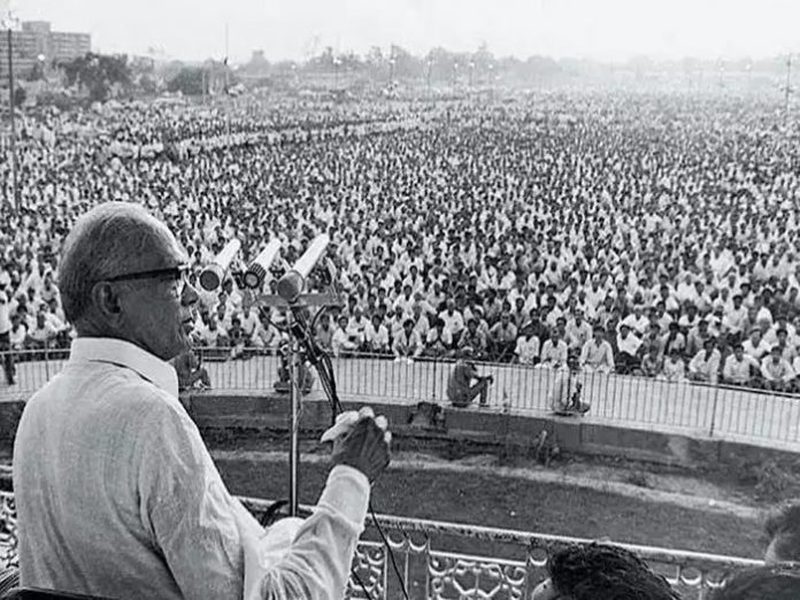
Before the Emergency, there was the movement that provoked it. In 1974-75, Jayaprakash Narayan, the veteran socialist and freedom fighter known as JP, led one of the largest mass mobilisations in Indian history, demanding the dismissal of corrupt governments, electoral reform and what he called Total Revolution. The JP Movement brought students, workers and opposition parties together, paralysed Bihar and Gujarat, and so threatened Indira Gandhi’s government that it became the justification for the Emergency.
Who was Jayaprakash Narayan
JP was a legend of the freedom movement who had renounced electoral politics after Independence, dedicating himself to Sarvodaya and grassroots work. His moral authority was unmatched: he had opposed Nehru, mentored a generation of socialists, and lived with deliberate simplicity. When student agitations erupted in Gujarat and Bihar in 1973-74 against corruption, price rise and unemployment, the young protesters invited the 71-year-old JP to lead them. His acceptance transformed scattered agitations into a national movement.
Total Revolution: what JP demanded
JP’s call for Sampoorna Kranti, Total Revolution, went beyond changing governments: he demanded a transformation of society, politics, economy and morality. Practically, the movement demanded the dissolution of the Bihar assembly, fresh elections, electoral reforms including the right to recall, an end to corruption, and decentralisation of power to the village level. The programme was idealistic and sometimes vague, but its moral core, that power must answer to the people, resonated across a country weary of inflation, scarcity and political arrogance. Critics found the programme utopian and short on specifics, but its power lay less in policy detail than in moral clarity.
How the movement unfolded
The movement’s methods were Gandhian: strikes, gheraos, tax boycotts and mass rallies, all nominally non-violent. JP toured Bihar drawing enormous crowds, students boycotted classes, and government functioning in parts of the state ground to a halt. The movement’s slogan, vacate the throne, the people are coming, captured its ambition to replace not just a government but a political culture. Opposition parties, from the Jana Sangh to the Socialists, rallied behind JP, creating the broad anti-Congress coalition that would later become the Janata Party. The movement’s peak came in June 1975, when JP led a massive rally in Delhi and controversially called on the police and army to disobey unjust orders.
Why it led to the Emergency
The convergence of the Allahabad High Court’s judgment against Indira Gandhi and JP’s call for her resignation created a crisis the government chose to answer with authoritarianism. On the night of 25 June 1975, JP was among the first arrested under the Emergency, and he spent months in detention that broke his health. The government blamed the movement for creating the anarchy that necessitated the Emergency; the movement’s supporters saw the Emergency as proof that their diagnosis of authoritarianism had been correct. Both claims contain truth: the movement’s disruption was real, and so was the government’s overreaction.
The movement’s legacy
The JP Movement’s greatest legacy was the generation it created. Leaders forged in its agitations, Lalu Prasad Yadav, Nitish Kumar, Arun Jaitley, Sushma Swaraj among them, dominated Indian politics for decades. It established the template for mass anti-corruption mobilisation that later movements, including the Anna Hazare agitation, would follow. And it demonstrated that moral authority, wielded by a leader who sought no office, could shake the most powerful government in the land. JP died in 1979, but the idea that citizens can demand Total Revolution never quite died with him. The movement also left institutional lessons: the 44th Amendment’s safeguards against Emergency abuse, the strengthening of the Election Commission, and a political culture in which mass mobilisation against corruption remains a legitimate, if disruptive, democratic tool.
FAQs
What was Total Revolution? JP’s call for comprehensive transformation of Indian society, politics and economy, beginning with the removal of corrupt governments and electoral reform.
Was the JP Movement violent? Its leadership insisted on non-violence, though the scale of disruption, strikes and gheraos, created conditions the government called anarchy.
How is the JP Movement remembered today? As the last great Gandhian mass movement, the precursor to the Emergency, and the training ground for a generation of political leaders.
The JP Movement asked Indians to imagine a democracy deeper than elections, and for two extraordinary years, millions of them did.
Compiled by the Khabar 24h Editorial Desk from publicly available sources.

Khabar 24h Editorial Desk — our explainers are prepared by the Khabar 24h editorial team using AI-assisted research tools, and every piece is reviewed by a human editor before publishing. We do not claim original reporting: our work is turning complex topics into simple, accurate summaries. Spotted an error? Write to contact@khabar24h.com — our corrections policy aims for same-day review.
More from this author →