Statue of Unity: How the World’s Tallest Statue Became a Tourism Economy
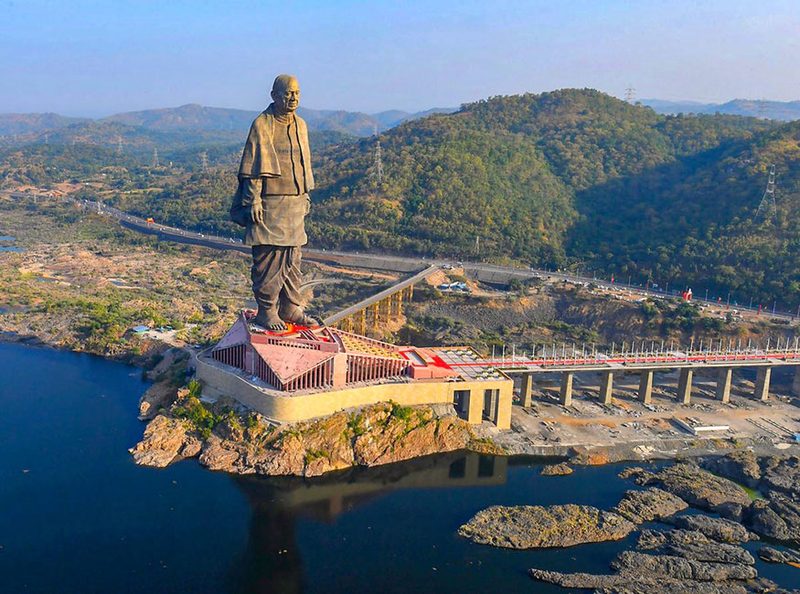
Rising 182 metres above the Narmada in Gujarat, the Statue of Unity, depicting Sardar Vallabhbhai Patel, is the tallest statue in the world, nearly twice the height of the Statue of Liberty. Inaugurated in October 2018, it was conceived as both a tribute to the Iron Man of India and an engine of tourism for a remote tribal region. It has succeeded beyond most expectations on the second count: the site draws lakhs of visitors annually, with a tent city, river cruises, jungle safaris, and a whole tourism ecosystem grown around the colossus. This is how the world’s tallest statue became a tourism economy.
Building the colossus
The statue’s construction was an engineering feat. Designed by sculptor Ram V. Sutar, the 182-metre figure, the height chosen to match the number of Gujarat’s assembly seats, stands on an island, Sadhu Bet, in the Narmada facing the Sardar Sarovar Dam. The structure comprises a steel framework and reinforced concrete core clad in 6,500 bronze panels, engineered to withstand winds of up to 180 kmph and earthquakes. Larsen and Toubro executed the construction, with bronze casting done in China, a detail that drew criticism, and assembly on site. The project cost around Rs. 3,000 crore, funded by the Gujarat government with public contributions. Completed in under five years, it set records for speed as well as scale: the world’s tallest statue, built faster than any comparable monument. The viewing gallery at 153 metres, in the statue’s chest, offers panoramic views of the Narmada valley.
The tribute: why Patel, why here
The choice of Sardar Patel was political and historical. As India’s first Home Minister, Patel integrated over 560 princely states into the Union, the achievement for which he is called the Iron Man and the unifier of India. The statue’s location in Gujarat, Patel’s home state, overlooking the Sardar Sarovar Dam, another monument to his vision, layers the symbolism. The project was championed by Narendra Modi from his chief minister days, and its inauguration on Patel’s birth anniversary, October 31, now observed as Rashtriya Ekta Diwas, National Unity Day, cemented the association. Critics questioned the expense and the politics of memorialisation; supporters argued that Patel, long under-honoured relative to his contribution, deserved a monument of civilisational scale. The debate over the statue’s cost and meaning accompanied its construction and has never fully faded, even as the tourist numbers rendered the economic argument moot.
The tourism economy
The transformation of the site’s surroundings is the project’s most tangible achievement. Kevadia, renamed Ekta Nagar, was a remote tribal area; it is now a tourism complex with hotels, a tent city, the Valley of Flowers, a jungle safari, a riverfront, cactus and butterfly gardens, a children nutrition park, and river cruises, all packaged as multi-day itineraries. Visitor numbers run into lakhs annually, with revenues from tickets, accommodation, and activities running into hundreds of crores. Connectivity was transformed: a new railway station, tent city infrastructure, and road upgrades. The employment effect on local tribal communities, as guides, hospitality staff, and vendors, is significant, though activists continue to raise questions about displacement, land, and whether the benefits reach the most marginalised. The statue demonstrated a proposition: in India, a well-executed monument can be a regional development strategy.
The statue race and its critics
The Statue of Unity ignited a competitive memorialisation: Maharashtra’s Chhatrapati Shivaji statue project off Mumbai’s coast, planned to exceed even Patel’s height, and other states’ proposals, raised the question of whether statue-building was becoming a substitute for development. Economists debate the opportunity cost: Rs. 3,000 crore could fund many schools or hospitals, though defenders note tourism revenues and the impossibility of reducing all public spending to utilitarian calculus. Environmental concerns about construction in the Narmada were raised and managed. The deeper critique is cultural: whether giant statues represent the best of commemorative imagination. The counter is democratic: lakhs of visitors, many of them poor Indians seeing a world-class attraction for the first time, vote with their feet, and their verdict has been enthusiastic.
A monument that worked
Whatever the debates, the Statue of Unity works as what it was meant to be: a tribute visible from afar and an economy up close. It put a remote Gujarat district on the world tourism map, gave the region infrastructure it would never otherwise have received, and created a template, for better or worse, for monument-led development. The bronze Patel gazes over the Narmada at a valley transformed in his name; the Iron Man who united India’s states now anchors one’s tourism. Monuments are arguments in stone and metal; this one argues that scale itself can be a strategy, and the lakhs who visit each year suggest the argument lands.
FAQs
How tall is the Statue of Unity? 182 metres, the world’s tallest statue, with a viewing gallery at 153 metres.
Where is it located? On Sadhu Bet island in the Narmada river near Kevadia, Gujarat, facing the Sardar Sarovar Dam.
How do I visit? Through Ekta Nagar: tickets for the statue, viewing gallery, and surrounding attractions are booked online, with rail and road connectivity from major Gujarat cities.
The Statue of Unity turned tribute into tourism and a remote river island into a destination. As the world’s tallest statue, it was always going to be noticed; as a development project, it has been more successful than its sceptics predicted.
Compiled by the Khabar 24h Editorial Desk from publicly available sources.

Khabar 24h Editorial Desk — our explainers are prepared by the Khabar 24h editorial team using AI-assisted research tools, and every piece is reviewed by a human editor before publishing. We do not claim original reporting: our work is turning complex topics into simple, accurate summaries. Spotted an error? Write to contact@khabar24h.com — our corrections policy aims for same-day review.
More from this author →