Why Bengaluru Floods Every Monsoon: Vanishing Lakes and the Stormwater Mess
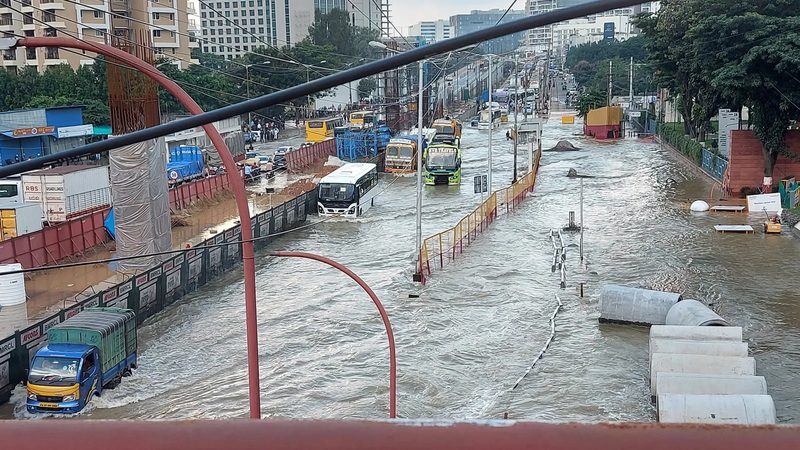
Bengaluru sells itself as India’s tech capital, a city of startups, campuses and pleasant weather. Every monsoon, a different city appears: streets turned to rivers, basements submerged, tech parks marooned, and residents navigating knee-deep water past stalled BMWs. The flooding of recent years, from the inundation of upscale layouts to the chaos on Outer Ring Road, has become an annual ritual of outrage. The causes are well documented and entirely human: the city has destroyed its lakes, concretised its stormwater drains, and built over the valleys that once carried rain away. This explainer traces how Bengaluru engineered its own floods.
The city of lakes that lost them
Bengaluru was built around a cascade of lakes, engineered centuries ago by Kempe Gowda’s planners and later rulers: each lake overflowed into the next through rajakaluves, the stormwater channels, creating a system that stored monsoon rain and recharged groundwater. The city once had over 200 such lakes. Today, a fraction survive in recognisable form; the rest have been encroached, built over, or reduced to sewage sumps. The lake cascade was Bengaluru’s flood insurance and water security in one system. Its destruction, through encroachment regularised by successive governments, removed both: the city now floods in the monsoon and runs short of water in summer.
How the drains were killed
The rajakaluves, the channels connecting the lakes, suffered the same fate: narrowed by encroachment, covered by roads and buildings, and choked with sewage and solid waste. A drain designed to carry a certain volume of stormwater cannot do so when half its width is a building and its bed is two metres of silt. The city’s stormwater drain remodelling projects have moved slowly, tangled in encroachment disputes where powerful interests built on drain land. Every flood inquiry reaches the same conclusion: the drains must be cleared and restored. Every year, the clearances remain incomplete when the monsoon arrives.
Concrete and the valleys
Bengaluru’s topography is a series of gentle valleys, the natural drainage paths. The city’s planning norms, in theory, protect valley zones from construction; in practice, layouts, tech parks and apartment complexes have marched across them. Paving replaces soil that once absorbed rain, so runoff that once percolated now rushes into the drains, multiplying peak flows many times over. The upscale layouts that flood most dramatically, often built on former lake beds and valley floors, are monuments to this planning failure. The residents who paid crores for “lake-view” apartments discover the lake’s revenge each monsoon.
The governance mess
Flood management in Bengaluru is split across agencies that barely coordinate: the municipal corporation handles drains, the lake development authority handles lakes, the water board handles sewage that chokes both, and planning authorities approve the layouts that create the problem. Jurisdictional disputes, from the long-pending municipal elections to the tussle over the city’s governance structure, have paralysed decision-making. Court orders to clear encroachments are implemented selectively. The pattern is familiar: after each flood, committees are formed, reports are written, and the next monsoon arrives with the drains still choked.
Can Bengaluru fix it?
The technical fixes are known: restore the lake cascade and its interconnecting channels, clear and desilt the rajakaluves, enforce valley-zone protection, mandate rainwater harvesting and permeable surfaces, and separate sewage from stormwater. Some of this is underway: lake rejuvenation projects, drain remodelling, and stricter enforcement drives have shown results in pockets. But the scale of encroachment and the political economy of regularisation make citywide restoration a generational task. Bengaluru’s floods are a choice the city makes every year it leaves the drains choked. Until that choice changes, the monsoon will keep collecting the bill.
FAQs
Why does Bengaluru flood every monsoon? Vanishing lakes, encroached and silted stormwater drains, construction on valleys and lake beds, and paved surfaces that multiply runoff.
What are rajakaluves? The traditional stormwater channels that connected Bengaluru’s cascade of lakes, many now encroached or choked.
Can the flooding be fixed? Technically yes, through lake and drain restoration, valley protection and better governance; politically and administratively, progress has been slow.
Bengaluru’s floods are not a natural disaster. They are the predictable output of a city that paved its lakes, built on its drains and called it development. The monsoon is only the messenger.
Compiled by the Khabar 24h Editorial Desk from publicly available sources.

Khabar 24h Editorial Desk — our explainers are prepared by the Khabar 24h editorial team using AI-assisted research tools, and every piece is reviewed by a human editor before publishing. We do not claim original reporting: our work is turning complex topics into simple, accurate summaries. Spotted an error? Write to contact@khabar24h.com — our corrections policy aims for same-day review.
More from this author →