Dholera: Inside India’s First Greenfield Smart City in Gujarat
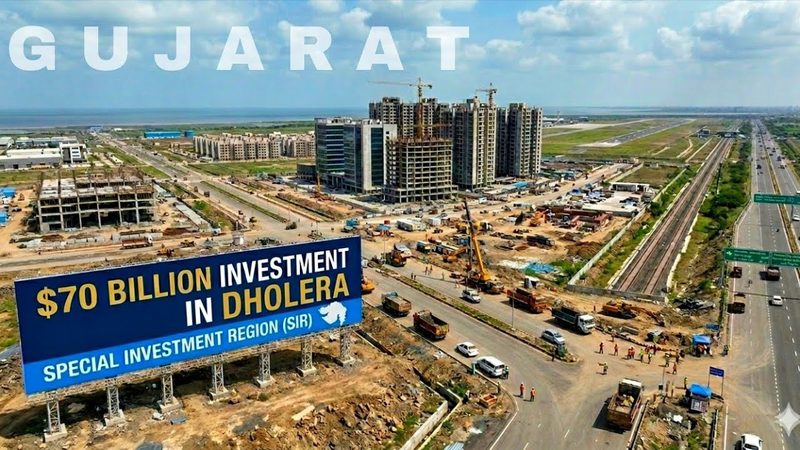
Most Indian cities grew organically over centuries, accumulating infrastructure deficits that smart-city retrofits can only partly fix. Dholera, on the Gulf of Khambhat in Gujarat, tries the opposite approach: a city designed from scratch on 920 square kilometres of mostly empty land, planned as India’s first greenfield smart city and industrial hub. Part of the Delhi-Mumbai Industrial Corridor, Dholera is being built with plug-and-play industrial infrastructure, a dedicated semiconductor ecosystem anchored by major fab investments, and smart-city systems embedded from day one. This explainer goes inside the most ambitious urban experiment in modern India.
The plan
Dholera Special Investment Region spans 920 sq km, of which about 540 sq km is developable, with the rest reserved for agriculture, green space and water bodies. The masterplan zones land for industry, residential areas, commercial districts, and social infrastructure, with wide arterial roads, underground utilities and a dedicated water and power backbone. The activation area, the first 22.5 sq km, has trunk infrastructure completed: roads, drainage, water treatment, power substations and an integrated command centre. The city’s pitch is simple: world-class infrastructure available on day one, without the land-title chaos, congestion and retrofit costs of existing cities.
The semiconductor bet
Dholera’s signature investment is in semiconductors: major fab and chip-packaging projects have been announced for the region under India’s semiconductor mission, with the Tata-PSMC fab and related ecosystem investments anchoring a “Semicon City” within Dholera. Semiconductors need what Dholera offers: vast land, assured ultra-pure water, uninterrupted power, and distance from urban disruption. If the fabs materialise and ramp up, they would anchor an electronics manufacturing ecosystem, suppliers, talent, logistics, of the kind that transformed Hsinchu in Taiwan. The bet is that chip manufacturing can do for Gujarat what it did for Taiwan: create an industrial identity for a generation.
Building a city from zero
Greenfield cities face a chicken-and-egg problem: people and firms won’t come without infrastructure and amenities, but infrastructure without users is a ghost town. Dholera’s answer is to lead with industry: factories first, then the housing, schools and hospitals that workers need. Land pooling and acquisition were completed early, avoiding the litigation that stalls most projects. Water, the critical constraint in the region, is addressed through a dedicated pipeline and treatment. Connectivity is being built outward: expressway links to Ahmedabad and Bhavnagar, a proposed rail link, and proximity to ports. The development corporation markets Dholera aggressively at investor summits, and land allotments to industries have picked up.
The ghost-town risk
Sceptics point to the global graveyard of planned cities that stayed empty: infrastructure without economic gravity becomes a monument. Dholera’s vast scale amplifies the risk: 920 sq km is larger than many established cities, and filling it will take decades. Critics also note the environmental cost of building on coastal land, the displacement of farming communities, and the water demands of both a new city and water-intensive fabs in a water-scarce region. The project’s defenders reply that every great industrial city looked empty at first, and that the semiconductor anchor provides the gravity previous greenfield attempts lacked. Time, as always with new cities, is the judge.
What Dholera means for India
If Dholera succeeds, it establishes a template: planned industrial cities as the answer to the congestion and land constraints strangling manufacturing in existing metros. The Delhi-Mumbai Industrial Corridor envisages several such nodes; Dholera is the test case. Success would also validate the strategy of anchoring new cities with a single transformative industry, the semiconductor bet. Failure would join the long list of Indian greenfield dreams that stayed on paper. Either way, Dholera is worth watching: it is the largest, most deliberate attempt to answer the question of where India’s next wave of urbanisation and manufacturing will physically go.
FAQs
Where is Dholera? On the Gulf of Khambhat in Gujarat, about 100 km from Ahmedabad, developed as a Special Investment Region under the Delhi-Mumbai Industrial Corridor.
How big is it? 920 sq km in total, with about 540 sq km developable, making it larger than most existing Indian cities in planned area.
Why semiconductors? Major fab investments have been announced for Dholera under India’s semiconductor mission, potentially anchoring an electronics manufacturing ecosystem.
Dholera is a city built on a wager: that world-class infrastructure plus a transformative industry can conjure a metropolis from empty land. India’s urban future may well be decided in places exactly like it.
Source: The Times of India

Khabar 24h Editorial Desk — our explainers are prepared by the Khabar 24h editorial team using AI-assisted research tools, and every piece is reviewed by a human editor before publishing. We do not claim original reporting: our work is turning complex topics into simple, accurate summaries. Spotted an error? Write to contact@khabar24h.com — our corrections policy aims for same-day review.
More from this author →