Ken-Betwa River Link: How India’s First River-Interlinking Project Works, and Why It’s Controversial
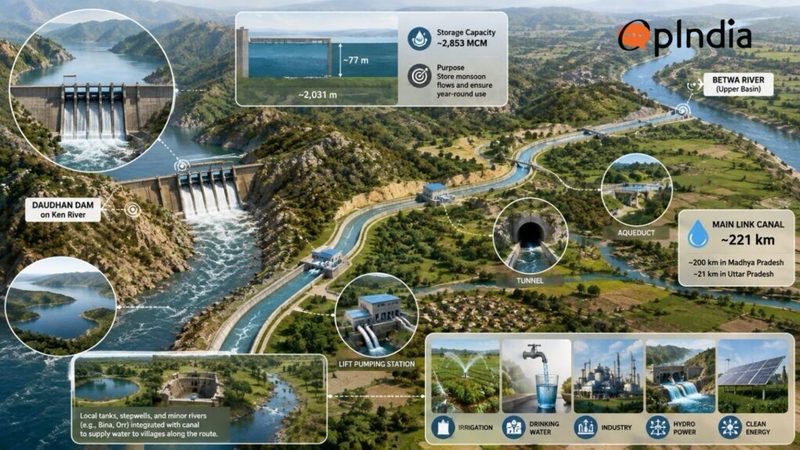
Of all India’s grand water projects, none is older in conception or more contested in execution than the interlinking of rivers. The Ken-Betwa link, the first project taken up under the national river-interlinking programme, proposes to transfer surplus water from the Ken river in Madhya Pradesh to the water-scarce Betwa basin, irrigating drought-prone Bundelkhand across Madhya Pradesh and Uttar Pradesh. The project involves a large dam, a 221-kilometre canal and the submergence of part of the Panna Tiger Reserve. Approved after decades of debate, it is now under construction. This explainer looks at how the link works and why it divides opinion so sharply.
How the link works
The project’s core is the Daudhan dam on the Ken river, which will store monsoon flows and divert water through a 221-km link canal to the Betwa basin. The water will irrigate over 10 lakh hectares, provide drinking water to lakhs of people, and generate hydropower. Bundelkhand, straddling the two states, is among India’s most drought-prone regions, with a history of crop failures, water scarcity and distress migration. For its supporters, the link is a straightforward proposition: move water from where it is surplus to where people are thirsty. The project also includes the renovation of the region’s traditional tank systems and micro-irrigation to use the new water efficiently.
The case for interlinking
The national river-interlinking vision, championed since the early 2000s, argues that India wastes enormous monsoon flows to the sea while large regions go thirsty, and that only large-scale transfers can fix the mismatch. Bundelkhand’s distress gives the argument moral force: this is a region where water scarcity has driven farmer suicides and mass migration. The project’s economic case rests on irrigation benefits, drinking water security and power generation, with the cost-benefit analysis showing strong returns. For Madhya Pradesh and Uttar Pradesh, which signed a long-delayed agreement to implement the project, it is also a political prize: a central project delivering water to a chronically neglected region.
Why ecologists oppose it
The opposition is formidable. The Daudhan dam will submerge over a hundred square kilometres, including critical tiger habitat in the Panna Tiger Reserve, one of India’s great conservation success stories, where tigers were painstakingly reintroduced after poaching wiped them out. Ecologists argue that the “surplus” water calculations are based on outdated data and that the Ken has no real surplus in most years. They warn of the disruption to river ecology, the submergence of forests, and the precedent: if the first link goes through a tiger reserve, no protected area is safe from the thirty-odd links in the national plan. The project’s clearances were granted amid controversy, with critics alleging that environmental concerns were overridden.
The science debate
Beneath the politics lies a genuine scientific dispute. Interlinking’s critics, including prominent hydrologists, argue that river basins are not bathtubs: transferring water alters sediment flows, delta formation, and the ecological rhythms of both donor and recipient rivers. They point out that India’s water problem is more about management, groundwater depletion, inefficient irrigation, than about absolute scarcity, and that local solutions like watershed development deliver more water per rupee. Supporters counter that local solutions cannot create water where none exists, and that Bundelkhand’s aquifers are too depleted for watershed work alone. The debate is ultimately about what kind of water future India wants: decentralised and ecological, or centralised and engineered.
What happens next
With construction underway, the Ken-Betwa link’s fate is now tied to execution: whether the dam, canal and resettlement are completed, whether the promised irrigation materialises, and whether the ecological damage stays within the assessed bounds. Its performance will shape the politics of the entire interlinking programme: success in Bundelkhand would revive the national plan, while cost overruns or ecological harm would strengthen the opposition. Either way, the project has already forced India to confront the hardest questions in water policy: how much engineering a river can bear, and who decides.
FAQs
What is the Ken-Betwa link? India’s first river-interlinking project, transferring water from the Ken river in MP to the Betwa basin to irrigate drought-prone Bundelkhand in MP and UP.
Why is it controversial? The Daudhan dam submerges part of the Panna Tiger Reserve, and critics dispute the “surplus water” calculations and the ecological costs.
How long is the link canal? About 221 km, carrying water from the Daudhan dam to the Betwa basin.
The Ken-Betwa link is where India’s water ambitions meet its conservation conscience. Bundelkhand needs water; Panna’s tigers need forest. The project insists both can be served. The coming decade will test that claim.
Compiled by the Khabar 24h Editorial Desk from publicly available sources.

Khabar 24h Editorial Desk — our explainers are prepared by the Khabar 24h editorial team using AI-assisted research tools, and every piece is reviewed by a human editor before publishing. We do not claim original reporting: our work is turning complex topics into simple, accurate summaries. Spotted an error? Write to contact@khabar24h.com — our corrections policy aims for same-day review.
More from this author →