Memory Techniques for Students: Mnemonics, Mind Maps and Memory Palaces
How do memory champions memorise a deck of cards in under a minute, or hundreds of random digits in order? They are not born with photographic memories — they use systems. The same systems, scaled down, can help a student master the periodic table, remember historical dates, or recall long biology processes without panic. Memory is a skill with techniques, and this guide teaches the three most powerful ones: mnemonics, mind maps and memory palaces.
Mnemonics: hooks for slippery facts
A mnemonic is a pattern that makes forgettable information memorable. The main types: acronyms (VIBGYOR for rainbow colours), acrostics (sentences where each word’s first letter encodes a fact — like the classic planet sentence), rhymes and jingles, and vivid visual associations (picture a giant KOH-I-NOOR diamond to remember that Kohinoor… well, you get the idea). The science: bizarre, funny or exaggerated images stick because the brain prioritises novelty and emotion. Create your own mnemonics rather than borrowing others’ — the act of creation is itself powerful encoding. Use mnemonics for lists, sequences, classifications and formulae: the p-block elements, taxonomic ranks, constitutional schedules, or trigonometric formulae all yield to a good hook.
Mind maps: thinking in trees
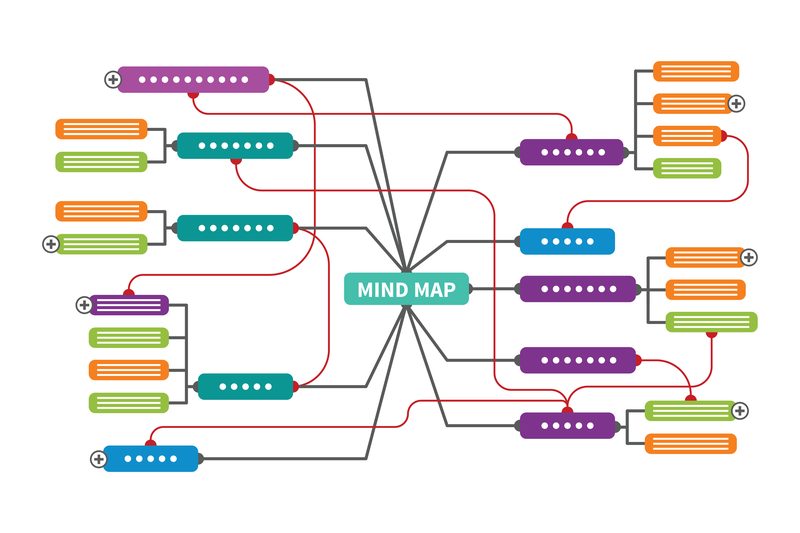
A mind map is a visual diagram that radiates from a central concept into branches and sub-branches, using keywords, colours and images. Unlike linear notes, mind maps mirror how the brain organises information — associatively, not sequentially. To build one: put the chapter title in the centre, draw 5-7 main branches for the key themes, and sub-branch details using single keywords (not sentences). Use colours for categories and small sketches for processes. Mind maps excel at big-picture subjects: a full chapter of History, the whole of Indian Polity’s fundamental rights, or an Economics chapter become one visual page. Reviewing a mind map takes minutes and rebuilds the entire chapter’s structure in your head — perfect for the final revision week.
Memory palaces: the ancient superpower
The method of loci — the memory palace — is 2,500 years old and still unbeaten for ordered information. Here is how it works: pick a familiar place (your home), define a fixed route through it (door, sofa, window, kitchen…), and place one vivid, bizarre image representing each fact along the route. To recall, mentally walk the route and collect the images. Students use it for speeches, the sequence of Mughal emperors, the steps of a chemical process, or lists of articles in the Constitution. Start small — ten loci in one room — and expand as the skill grows. The first palace feels slow; by the third, the method clicks, and ordered recall becomes almost automatic.
Which technique for which task
- Lists and sequences: mnemonics and memory palaces (dates, articles, elements, steps).
- Big-picture understanding: mind maps (chapters, interlinked concepts, essay frameworks).
- Formulae and reactions: mnemonics plus spaced-repetition flashcards.
- Speeches and answers: memory palaces for structure, mind maps for content.
- Diagrams and processes: redraw from memory repeatedly — the visual-motor loop is its own technique.
Making it stick: the practice protocol
Techniques fail without the two multipliers: spaced repetition and active recall. Build your mind maps and palaces, then revisit them on the 7-15-30 rhythm — each revisit takes minutes because the structure is already built. Test yourself by reproducing maps from memory on blank paper. And respect the limits: these techniques organise and anchor memory, but they cannot replace understanding. Build the concept first with normal study, then encode it with these systems. Ten minutes of technique practice daily, sustained over months, transforms what feels like a bad memory into a reliable one.
FAQs
Do these techniques really work for Indian exams? Yes — they are content-agnostic. Toppers in medicine, law and civil services use them for exactly the fact-heavy syllabi Indian exams demand.
Isn’t this too time-consuming? The setup takes time; the payoff is revision speed. A chapter encoded well revises in minutes instead of hours.
Can young children use them? Absolutely — mind maps work from primary school, and children take to vivid mnemonics faster than adults.
Your memory is not fixed — it is trainable. Hook the facts, map the chapters, palace the sequences, and stop blaming a brain that was never taught how to remember.
Compiled by the Khabar 24h Editorial Desk from publicly available sources.

Khabar 24h Editorial Desk — our explainers are prepared by the Khabar 24h editorial team using AI-assisted research tools, and every piece is reviewed by a human editor before publishing. We do not claim original reporting: our work is turning complex topics into simple, accurate summaries. Spotted an error? Write to contact@khabar24h.com — our corrections policy aims for same-day review.
More from this author →