Reading the Rains: How the IMD Forecasts the Southwest Monsoon, and What El Nino Means for India’s Crops
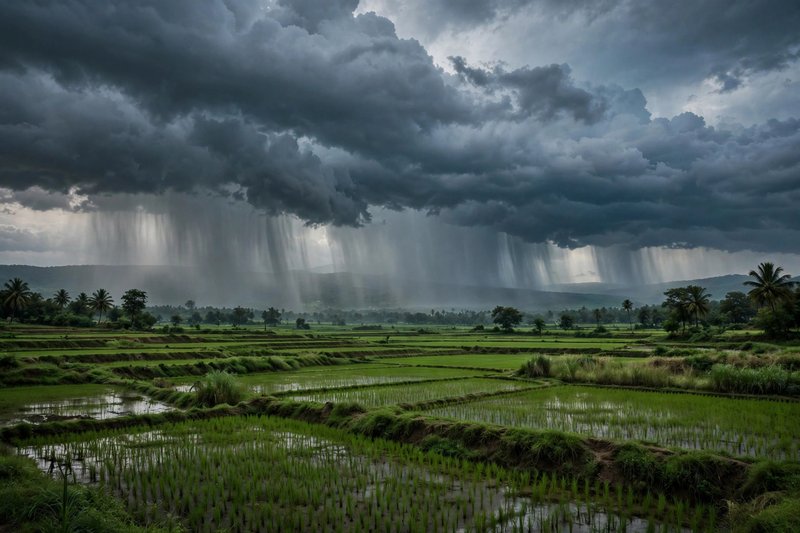
On April 13, 2026, the India Meteorological Department delivered a warning it had not issued in eleven years: the southwest monsoon would likely be “below normal,” at 92 per cent of the Long Period Average, with a model error of plus or minus 5 per cent. The reason, the IMD said, was a likely El Nino developing during the monsoon months. Here is how the country’s weather scientists arrive at such calls, and what the Pacific’s mood swings mean for Indian farms.
How the IMD builds its forecast
Since 2003, the IMD has issued its operational long-range forecast for June-to-September rainfall in two stages — a first forecast in April and an update in the last week of May. Since 2021, it has used a new strategy combining dynamical and statistical models: a Multi-Model Ensemble of coupled global climate models from prediction centres around the world, anchored by the IMD’s own Monsoon Mission Climate Forecast System. The Long Period Average — the benchmark everything is measured against — is 87 cm of seasonal rainfall, averaged over 1971 to 2020.
Beyond the national number, the IMD issues forecasts for the country’s four homogeneous rainfall regions and for individual months, updating them as the season progresses. The monsoon typically arrives over Kerala around June 1, advances to cover the entire country by mid-July, and begins withdrawing from the northwest in mid-September. The department tracks this advance and withdrawal in near real time through its network of observatories, automatic weather stations and satellites — data that feeds into agromet advisories issued to farmers twice a week during the season.
What “below normal” actually means
The IMD grades seasons in five bands:
- Deficient: below 90 per cent of the LPA
- Below normal: 90 to 95 per cent
- Normal: 96 to 104 per cent
- Above normal: 105 to 110 per cent
- Excess: above 110 per cent
India’s last reduced monsoon was 2023, forecast at 96 per cent; in 2015, a below-normal forecast at 93 per cent turned out optimistic — actual rainfall was 86 per cent, one of the worst drought years in recent memory. For 2026, the IMD’s probability outlook gave a 35 per cent chance of deficient rainfall — far above the climatological 16 per cent — 31 per cent below normal, 27 per cent normal, and only 7 per cent combined for above normal or excess.
El Nino, La Nina and the Indian Ocean Dipole
El Nino — a periodic warming of the central and eastern equatorial Pacific — is associated with weaker monsoon winds and drier conditions over India. Since 1950, it has emerged 16 times and depressed India’s monsoon in nine of those years. Its converse, La Nina, involves cooler Pacific waters and generally supports stronger monsoons. In early 2026, weak La Nina-like conditions were transitioning to neutral, but the IMD’s models suggested El Nino conditions developing during the monsoon season, with effects likely strongest in August and September. Two other drivers shape the outcome: the Indian Ocean Dipole, currently neutral but expected to turn positive late in the season — a positive IOD, with warmer waters in the western Indian Ocean, tends to support rainfall — and Eurasian snow cover, which has an inverse relationship with the monsoon and was slightly below normal in early 2026.
What it means for farms and food prices
Roughly half of India’s farmland depends on the monsoon rather than irrigation, making the June-to-September rains the single biggest variable in the rural economy. A weak monsoon hits kharif sowing of rice, pulses and oilseeds, and past droughts have forced the government to restrict grain exports to protect domestic supplies. With disruptions to fertiliser supply already a concern ahead of the kharif season, the 2026 forecast put farm incomes and food inflation squarely on the watchlist.
Compiled by the Khabar 24h Editorial Desk from publicly available sources.

Khabar 24h Editorial Desk — our explainers are prepared by the Khabar 24h editorial team using AI-assisted research tools, and every piece is reviewed by a human editor before publishing. We do not claim original reporting: our work is turning complex topics into simple, accurate summaries. Spotted an error? Write to contact@khabar24h.com — our corrections policy aims for same-day review.
More from this author →
Leave a Reply